
A beginner's guide to understanding marketplace fundamentals
What Is an Online Marketplace? Definition, 4 Types & Examples
A plain-English guide to what an online marketplace is, how it differs from an online store, the 4 main types, and real examples from Amazon to Airbnb.
Many people start with tools, features, or design ideas. But marketplaces don't succeed because of interfaces. They succeed because they enable real transactions between real people, supported by trust, rules, and incentives.
An online marketplace is fundamentally a system that allows two or more groups - usually buyers and sellers - to interact and exchange value through a shared platform.
Examples include Amazon (products), Airbnb (rentals), Uber (rides), Fiverr (services), Etsy (handmade goods), and eBay (auctions).
Unlike an online store - which has one seller and many products - a marketplace has many sellers and many buyers, with the platform handling discovery, payments, and trust.
If you want a clear, beginner-friendly explanation, you can also watch the video version of this guide:
Read the full video transcript▼
Intro (0:00)
Most people who say they want to build an online marketplace actually have no idea what an online marketplace is. And that's not an insult - I didn't know either when I first started out.
I've built four online marketplaces recently. Two failed, one is barely working, and one is actually working quite well. Only after building all of them did I really realize what an online marketplace is - and maybe more importantly, what it is not. So in this video, I'm going to take you through what exactly an online marketplace is, with real examples, so you don't waste months building something that isn't one. If you're an online marketplace beginner, this video will save you a lot of confusion.
The 4 marketplaces I've built (and what they taught me) (0:43)
Let me give you some context. Over the years I built multiple marketplaces. One was a marketplace for buying and selling podcast ads. Another was a marketplace for turning your home into a co-working space. Both of those failed. Then I built a marketplace where people can buy and sell stars - kind of a fun marketplace. That one exists, but it's not very active. And then I built a collector's marketplace for buying and selling Moomin mugs, which is actually quite popular in the Nordic region. That one is active - transactions every week.
Here's the important part: building each of these taught me something different about what a marketplace really is. This didn't come from theory - it came from painful mistakes. So everything I'm about to explain comes from building these things in the real world, not just from reading blog posts.
What is an online marketplace? (Simple definition) (1:38)
Let's start simple. An online marketplace is a platform that allows two or more groups of people to transact with each other. Usually it's buyers, sellers, and the platform in the middle. The keyword here is transaction. A marketplace isn't just about listings - it's about money, trust, and rules.
A real marketplace has five core elements: Supply - people offering something. Demand - people who want it. Transactions - real money flowing through the platform. Trust - reviews, ratings, some kind of protection. Rules - what happens when something goes wrong. If any of these are missing, you don't really have a real marketplace.
What a marketplace is NOT (directory, store, SaaS) (2:36)
A marketplace is not a directory. A directory just lists people or businesses, and once they find each other, they leave the site. No transactions, no enforcement, no reason to come back. In a real marketplace, money flows through the platform - and because of that, the platform matters.
A marketplace is not an ecommerce store. In an ecommerce store, you're the seller - and the only seller. You own the inventory and you control the supply. In a marketplace, you as the marketplace owner don't actually own anything. Other people are creating the value on your marketplace. If you think like a store owner when building your marketplace, you'll almost always fail.
A marketplace is not a SaaS tool. SaaS products win by adding features. Marketplaces win by getting people to show up. Most marketplaces don't fail because features are missing - they fail because they can't get both sides to connect and meet. This is probably the biggest mental shift beginners struggle with.
Why most marketplaces fail (3:36)
This is why most marketplaces fail. It's not the idea, and it's not the tech. It's that no one shows up. No listings, no buyers, no transactions. That's the main reason marketplaces fail - and that's what I learned when I built my first couple of marketplaces. I was focused too much on the tech and not enough on how I was actually going to get the first listings, then buyers, and get them to transact.
A marketplace is not just a website. It's a system that needs momentum all the time.
Types of online marketplaces (with real examples) (4:36)
There are four main types of marketplaces.
General marketplace - flexible for any type of listing. A good example is Craigslist, where you can sell pretty much anything.
Product marketplace - ecommerce-style, involves shipping. When a seller receives an order, they ship it to the buyer. A good example is Etsy.
Rental marketplace - we all know this one. Airbnb is the best example. As a seller, you put up your apartment for rent, and buyers rent it when you're not using it.
Service marketplace - the best example is Upwork. You offer your service to do something for the buyer. Project-based work, consultations, and so on.
Final takeaways (6:00)
If you take one thing away from this video, it's this: a marketplace is not just a website, it's not just a store, and it's not just a directory. It's a system that enables transactions between strangers.
If you're thinking about building an online marketplace, drop your marketplace idea in the comments and I'll give you my feedback.
The Core Elements of an Online Marketplace
Every functioning marketplace, regardless of size or niche, is built on the same foundations:
- Supply - people offering products, services, or access
- Demand - people actively looking for those offerings
- Transactions - money or value flowing through the platform
- Trust - reviews, ratings, protections, and accountability
- Rules - clear processes for disputes, cancellations, and misuse
If one of these elements is missing, the platform is usually not a true marketplace.
What an Online Marketplace Is Not
One of the most common mistakes beginners make is confusing a marketplace with other types of platforms.
A marketplace is not:
- A directory that only lists people or businesses
- An e-commerce store where you own the inventory
- A SaaS product where users pay only for software access
In a real marketplace, participants rely on the platform to complete transactions safely and fairly. The platform itself plays an active role in enabling trust and structure.
Common Types of Online Marketplaces
While all marketplaces share the same core principles, they can take very different forms. Each type has different requirements for listings, pricing, fulfillment, and trust:
Product marketplaces
Physical or digital goods sold by independent sellers, with shipping or digital delivery. Examples: Amazon (general retail), Etsy (handmade and vintage), eBay (auctions and resale), Mercari (peer-to-peer resale).
Service marketplaces
People offering skills, time, or expertise - usually project-based or hourly. Examples: Fiverr (gig-based services), Upwork (freelance work), Toptal (vetted top talent), Thumbtack (local services).
Rental marketplaces
Temporary access to spaces, vehicles, or equipment - calendars and availability matter more than inventory. Examples: Airbnb (homes and apartments), VRBO (whole-home vacation rentals), Turo (peer-to-peer cars), Outdoorsy (RVs and campers), Hipcamp (campsites).
On-demand marketplaces
Real-time matching between buyers and providers, often location-based and with strict timing. Examples: Uber (rides), Lyft (rides), DoorDash (food delivery), Instacart (grocery delivery), Rover (pet sitting and walking).
B2B marketplaces
Businesses buying from or selling to other businesses, usually with higher order values and more procurement workflow. Examples: Alibaba (global wholesale), Faire (independent retailers), Mirakl (enterprise marketplace platform), Knowde (chemicals and ingredients).
General marketplaces
Flexible platforms that allow many types of listings - product, service, rental, or anything else. Examples: Craigslist (general classifieds), Facebook Marketplace (local resale and rentals).
Choosing the right type matters, because it determines how your marketplace handles listings, payments, availability, and trust. A rental marketplace built on product-marketplace assumptions will fail at scheduling. A B2B marketplace built on B2C assumptions will fail at procurement workflows.
Why Understanding This Matters Before You Build
Most marketplaces fail not because the idea is bad, but because the structure doesn't match the behavior of the users.
Understanding what an online marketplace is at a conceptual level helps you:
- Avoid building the wrong features
- Choose the right marketplace structure early
- Focus on behavior and transactions instead of interface polish
This clarity makes every later decision - validation, design, and growth - much easier.
Learn More About Building Marketplaces
This page is part of a broader learning path focused on helping founders think clearly about marketplaces before they start building.
From here, you can continue learning about validating marketplace ideas, avoiding the cold start problem, and choosing the right structure for your use case.
Trusted by Marketplace Founders
“Highly Customizable, Exceptional Support”
“I find Prometora incredibly intuitive and easy to structure, much like Lego blocks… I've tried many alternatives, but Prometora was the only one that didn't limit my vision. Additionally, the support from Rasmus and the Prometora Team is exceptional.”
Antoanella P.
Founder
“Comprehensive, Ever-Improving System with Excellent Support”
“It is a comprehensive system that is constantly being improved and new functionalities are added. And if you are missing a function, you can contact Prometora and ask them to develop it - and they are very responsive… Prometora takes care of everything a web developer would have done in our company, so we can do without that part.”
Torben M.
CEO
“User-Friendly Marketplace Builder with Super Helpful Support”
“It's an excellent, user-friendly tool for any beginner who wants to kickstart a marketplace website quickly and start testing an idea without worrying about the technical side of things… Prometora makes it possible for a complete beginner to launch a working, fully functional marketplace within a couple of weeks.”
Verified User
Non-Profit Organization Management
Reviews collected by and hosted on G2.com
Ready to start your own online marketplace?
You now know what a marketplace is - and what it isn't. Next: the playbook.
How to start an online marketplace
The 5-step path from idea to first paying transaction: validate your niche, pick the model, set up Stripe Connect, launch fast, and get your first 10 transactions manually.
Read the guideHow to build a multi-vendor marketplace
Already set on independent sellers plus a commission? The deeper playbook: split payments, seller KYC, payouts, and recruiting your first 10 sellers.
Read the guideFrequently Asked Questions
Each connects buyers with independent sellers or providers, and the platform facilitates the transaction.
Other revenue models include subscription fees for sellers, listing fees, featured placement, and premium tools. You can learn more about marketplace revenue models in our revenue guide.
All marketplaces are platforms, but not all platforms are marketplaces - for example, a social network is a platform but not a marketplace.
The marketplace side - Amazon Marketplace - connects millions of independent sellers with buyers, with Amazon handling payments and logistics.
Most importantly, they make transactions happen - not just browsing.
However, it can create conflicts of interest - if you compete with your own sellers, trust can erode. Most new marketplaces start as pure marketplaces to build seller trust before considering hybrid approaches.
A marketplace has many independent sellers selling to buyers. You don't own the inventory - your sellers do. Your job is to enable the transactions, not fulfill them. Examples: Amazon (the marketplace side), Etsy, eBay, Airbnb.
This is the single most common confusion for first-time founders. If you're trying to think about supply, pricing, and shipping the way a store owner does, you'll fail. In a marketplace, your job is matching, trust, and rules.
Once a marketplace reaches liquidity (enough supply and demand to sustain transactions), the unit economics tend to be excellent: high margins (commission of 5-20% on transactions you don't fulfill), strong network effects, and scaling without proportional cost increases. Read more on this in our guide on the chicken-and-egg problem.
By niche dominance: Airbnb in vacation rentals, Etsy in handmade goods, Fiverr in gig services, Uber in ride-hailing. Each of these is the default for its category.
For a step-by-step playbook, see our guide on how to start an online marketplace.
B2B (business-to-business) marketplaces sell between businesses - Alibaba, Faire, Knowde. Order values are typically $1,000-$100,000+, sales cycles can take weeks, and trust is built through verification, contracts, and procurement workflows. B2B marketplaces also need features B2C doesn't: bulk pricing, NET 30/60 payment terms, RFQ (request for quote) flows, and approval chains.

Related Guides
Keep going - these cover the next questions most marketplace founders have.

Marketplace Fundamentals
How to Start an Online Marketplace in 2026: 5-Step Playbook
The complete guide to going from idea to launch - without wasting months or money

Marketplace Fundamentals
Ecommerce Marketplace 2026: How to Build One Like eBay or Etsy
Tutorial
Research
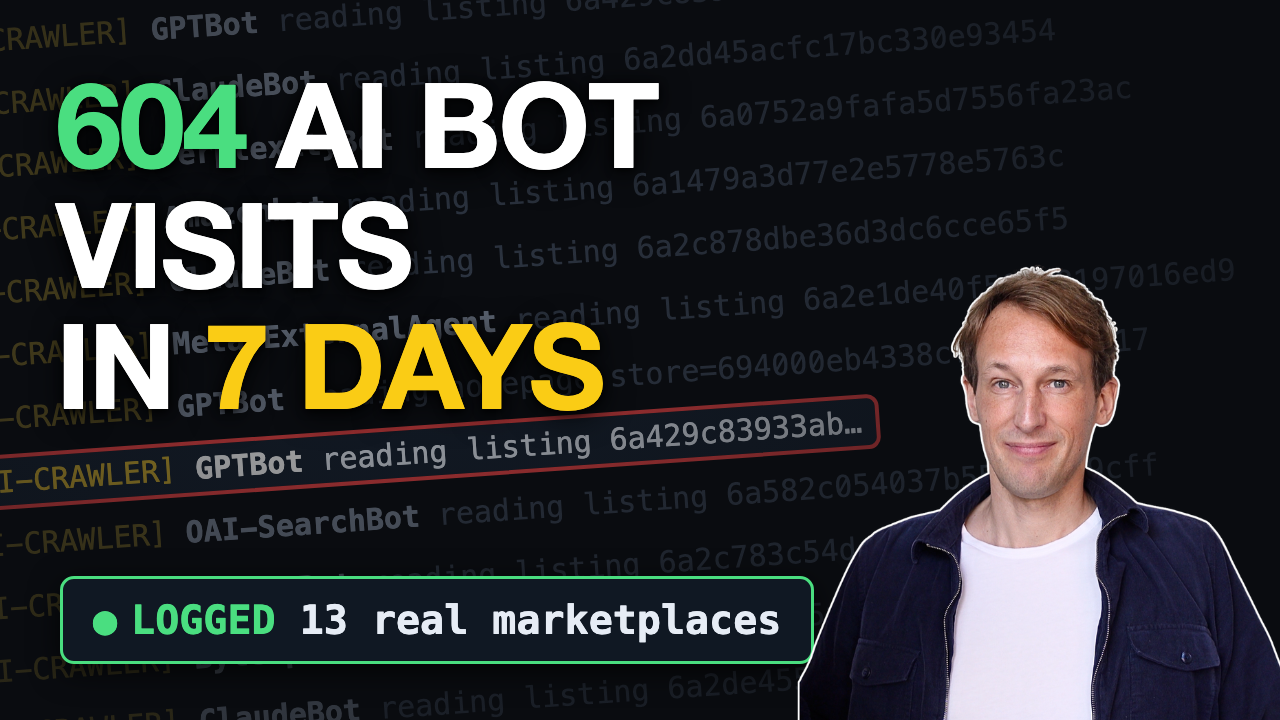
What AI Crawlers Actually Read: 7 Days of Data From 13 Real Marketplaces
604 logged visits · 11 AI bots · 7 days
Ready to build your marketplace?
Turn your marketplace idea into reality. No coding required.
Start Free Trial