
15 proven strategies to break the cold start loop and get your first users
Chicken and Egg Problem: 15 Ways Real Marketplaces Solved It
No buyers without sellers, no sellers without buyers. 15 proven strategies to break the loop - with real examples from Airbnb, Uber, Robinhood, and Reddit.
No buyers without sellers. No sellers without buyers. Every marketplace founder hits this wall. It's called the chicken and egg problem - and it kills more marketplace startups than bad ideas, bad design, or bad timing combined.
The chicken and egg issue is the core reason why building a marketplace is harder than building a regular product. You're not convincing one group of users to show up - you need two sides to show up, and each side only comes if the other is already there.
But this problem is solvable. In this guide, I break down 15 proven strategies that real marketplaces - from Airbnb to Robinhood to Clubhouse - have used to break the loop and get their first users. (If you're earlier in the journey and haven't picked a niche yet, start with the broader playbook on how to start an online marketplace first.)
Read the full video transcript▼
Introduction (0:00)
This issue affects all marketplaces out there, and if you don't solve it, your marketplace is unfortunately going to die. If you've ever tried to build and launch an online marketplace, you've probably encountered this issue: no buyers without sellers, no sellers without buyers - the classic chicken and egg problem. It kills most online marketplaces before they even get going.
In this video I'll break down exactly what this problem is, why it's a huge deal, and the top strategies to solve it.
What is the Chicken and Egg issue? (0:33)
Let's say someone launches a marketplace for renting out your spare desk. Who's the idiot that made that marketplace? That's the worst idea ever. Okay, I admit it - I was the idiot who made that marketplace, and I thought it was a great idea. It turned out it was not. I only managed to get one listing, and that was my own.
But it illustrates the chicken and egg issue really well. You're not going to get any buyers if you only have one listing - and how are you going to get more listings if you don't have any buyers? Imagine a store with no customers, or someone waiting for a taxi but there are no taxis, or someone making a profile on Tinder but getting no matches. Same issue.
This affects every marketplace. Look at Airbnb: if there are no homes, there are no guests; if there are no guests, there are no homes. Look at Uber: no riders means no drivers, and no drivers means no riders. So if you don't solve it, your marketplace is going to die.
The 15 Ultimate Strategies to solve it (1:43)
But don't worry - in this video I'm going to give you 15 strategies to solve it. Let's do it.
Strategy 1: Focus on one side first (1:53)
Most successful marketplaces focus on one side first, and usually that's the supply side. Uber got drivers before riders. Airbnb got listings before guests. Focus on one side and make that work. Without supply, buyers will just leave - and vice versa.
Strategy 2: Go niche and dominate a small market (2:14)
Don't try to be the next Amazon immediately. Focus on a niche instead. Facebook initially launched only to Harvard students. Airbnb launched in just one city. Focus on a small, engaged audience first - and the more niche you go, the better.
For NinjaBuzz, the marketplace I built for selling host-read podcast ads, it was initially just "selling ads to podcasters." But I found out people actually wanted to buy and sell host-read podcast ads specifically - so that's where I pivoted.
Strategy 3: Fake it till you make it (2:50)
Have you ever wondered how so many marketplaces get a lot of listings overnight? Often, they fake them. You can do this too - but be careful, because if people find out, they'll leave. Airbnb did this early on to look more alive. Match.com has been known to create fake women's profiles on their platform. Yes, you heard that right.
Strategy 4: Steal from other marketplaces (3:17)
Some of the biggest marketplaces have admitted to scraping other platforms to seed their supply side. The Airbnb founders famously messaged people on Craigslist and convinced them to also list on Airbnb. This can work - but again, be careful, because you can get banned or worse.
Strategy 5: Lie (be very careful about this!) (4:00)
Another shady tactic is lying to attract supply - for example, claiming you're about to get funded so listers will benefit financially later. This works only if you actually do get funded. If you don't, you're screwed: the listers will leave and badmouth your marketplace. Be very careful with this one.
Strategy 6: Find the whale(s) - treat them as kings (4:40)
In every marketplace there's always a whale or two - sometimes five - that you should treat like kings. For NinjaBuzz, I figured out which podcasters knew all the other podcasters, and I quickly set up interviews and blog posts about them, even though my following was small. I replied to their emails immediately and did everything to keep them happy so they'd talk positively about the marketplace.
I did the same for Nordic Mugs. I noticed one woman who was super active in the relevant Facebook groups, reached out, got her to list, and then implemented every piece of feedback she sent me. That kind of attention turned her into an advocate.
Strategy 7: Pay them to join (6:02)
If you have the money, just pay them. Uber paid drivers in the early days. OpenTable did something similar with restaurants. This requires VC money, but if you can raise it before launching, this is a fast way to seed supply.
Strategy 8: Build a supplementary product (6:33)
If you can build something that delivers value before the marketplace exists, you'll already have traffic when you launch. LinkedIn did this with a resume builder before they had both sides of the network. People came in, got value, and eventually the marketplace formed around them. Highly recommended if you can pull it off.
Strategy 9: The "WOOOW!" strategy (my favorite) (7:24)
If you can create a marketplace that's dramatically different from anything out there, both sides will show up immediately. Examples: Napster - free music downloads at a time when that didn't exist. Canva - free, easy graphic design when it was hard and expensive. Robinhood - commission-free trading when every other broker charged. All three got both sides almost overnight, and Robinhood is now a multi-billion-dollar company.
Strategy 10: Create FOMO (8:45)
People want what they can't have. We're all lemmings. If you can create FOMO around your marketplace, that's a huge driver. The best example is Clubhouse: they launched during COVID, got Elon Musk on early, and ran an invite-only waitlist. I remember really wanting to get in. Once I did, I barely used it - but the FOMO worked.
Strategy 11: Launch on communities (9:47)
Find communities where your audience already hangs out. Reddit is amazing for this - there's a subreddit for almost every niche. Find the one that fits your marketplace and launch there to get your first batch of users (usually on the supply side). Then move to the next community.
Strategy 12: Leverage influencers (10:18)
If you know an influencer in your niche, try to bring them in as a partner - even give them equity. A great example: Clerk (not a marketplace, but the principle holds) brought on Theo, the YouTuber, as part of the company. He posts about Clerk regularly, and now I'm using Clerk because of it.
In marketplaces, Gamerpay is a great example. Gamerpay sells skins for gamers, and one of their co-founders ran a Facebook group with over 100K members in that exact niche. Launching there gave them their entire supply side almost instantly.
Strategy 13: Offline meetups (11:28)
Use Meetup.com or similar to run an in-person event, then convert attendees into your first users. It's not scalable, but you get direct feedback and build serious loyalty with your earliest users.
Strategy 14: Time your launch perfectly (11:54)
If you can connect your launch to a seasonal moment or industry event, you'll get extra buzz. Airbnb famously launched around a major US conference. Clubhouse launched during COVID. If you can find a relevant moment to ride, do it. If not, just launch.
Strategy 15: A market where the chicken is also the egg (12:30)
Sometimes the same users fit both sides. With NinjaBuzz, podcasters listed their shows for advertisers - but many of those same podcasters also wanted to buy ads on other podcasts to grow their own audience. When supply is also demand, the cold start gets way easier.
How I did it for Nordic Mugs, NinjaBuzz and My Spare Desk (13:13)
For Nordic Mugs, I launched in Facebook groups where I could see real activity in the niche, and I partnered with the most active member.
For NinjaBuzz, I launched on Reddit in a relevant community, which gave me 50-70 initial listings - and then I realized those listers were also potential buyers. Both sides solved at once.
For My Spare Desk, I launched on Reddit, Hacker News, and Product Hunt - and I didn't get a single listing. The only listing on the platform was my own. That's how it goes sometimes.
Key lesson (14:19)
Marketplaces are hard. You won't always solve the chicken and egg problem. But I really hope these strategies help you on your journey.
Speed Build Marketplace (14:37)
If you're interested in building and launching marketplaces, check out my boilerplate for quickly launching a marketplace MVP - Speed Build Marketplace.
Comment if I'm missing a strategy (14:50)
If you liked this video, comment with any strategies I missed.
Outro (14:58)
Please subscribe and like - it really helps. Thanks so much, and see you in the next one.
What Is the Chicken and Egg Problem?
The chicken and egg problem (also called the cold start problem) is the fundamental challenge every marketplace faces: your platform has no value until both sides are active.
A marketplace with great sellers but no buyers is useless. A marketplace with eager buyers but no listings is useless. You need both - and neither wants to go first.
This is different from a regular SaaS product or ecommerce store. Those only need to convince one type of user. Marketplaces need to solve a coordination problem - and most founders underestimate how hard that is.
Why It Kills Most Marketplaces
Most marketplace startups don't fail because the idea is bad. They fail because:
- They launch to an empty platform - no listings, no activity, no reason to stay
- They try to grow both sides simultaneously and make progress on neither
- They spend months building features instead of solving the cold start first
- They run out of motivation before the flywheel starts turning
The marketplace graveyard is full of well-built products with zero users. Solving the chicken and egg problem isn't optional - it's the first thing you need to figure out.
Prometora, a marketplace builder, handles the platform side end-to-end: listings, search, Stripe Connect payouts, seller dashboards, refunds. You set your commission and focus on the 15 strategies below. See Prometora pricing, the multi-vendor marketplace builder, or how Prometora compares to Sharetribe.
15 Proven Strategies to Solve the Chicken and Egg Problem
These strategies aren't theoretical. They've been used by the most successful marketplaces in the world - and by scrappy founders launching niche platforms from their laptops. Pick the ones that fit your situation.
All 15 strategies at a glance
Click any strategy to jump to its detailed breakdown below. Use this to spot which 2-3 fit your budget, timeline, and stage.
| Strategy | Cost | Effort | Speed | Best for | Example |
|---|---|---|---|---|---|
| 1. Focus on one side first | Free | Medium | Medium | Most marketplaces | Uber (drivers before riders) |
| 2. Go niche and dominate | Free | Low | Fast | Unfunded founders | Airbnb (one city only) |
| 3. Fake it till you make it | Free | High | Fast | Pre-launch supply | Airbnb (seeded listings) |
| 4. Be the first seller | Free | High | Fast | Solo founders | Run the first jobs yourself |
| 5. Strategic misrepresentation | Free | Low | Fast | Last resort only | Use sparingly |
| 6. Find the whales | Free | High | Medium | Niche communities | NinjaBuzz (top podcasters) |
| 7. Pay them to join | $$$ | Low | Fast | Funded startups | Uber driver bonuses |
| 8. Build a supplementary product | $$ | Very high | Slow | Patient founders | LinkedIn (resume builder) |
| 9. The "WOOOW!" strategy | Varies | Very high | Fast | Bold model changes | Robinhood (free trading) |
| 10. Create FOMO | Free | Medium | Fast | Consumer launches | Clubhouse (invite-only) |
| 11. Launch on communities | Free | Low | Fast | Niche markets | NinjaBuzz on Reddit |
| 12. Leverage influencers | $-$$$ | Medium | Fast | Defined niches | Clerk + Theo |
| 13. Offline meetups | $ | High | Slow | Local & B2B | Meetup.com events |
| 14. Time your launch perfectly | Free | Low | Event-tied | Seasonal businesses | Airbnb (DNC convention) |
| 15. Chicken = egg market design | Free | Design-level | Built-in | P2P / swap models | NinjaBuzz (podcasters trade ads) |
Strategy 1: Focus on One Side First
Don't try to grow both sides at once. In most marketplaces, you should start with supply (sellers, providers, hosts). Why? Because buyers come for inventory. If you have quality listings, demand follows. If you have no listings, no amount of marketing will help.
Real-world examples: Uber paid drivers to be online before there were any passengers. Airbnb obsessed over listings before they spent a dollar on guest acquisition. Both picked the harder side, locked it down, and only then turned on demand. Pick your hard side and go all-in on it before anything else.
Strategy 2: Go Niche and Dominate a Small Market
Trying to be "the marketplace for everything" is a death sentence at launch. Instead, pick a narrow niche - a specific category, location, or audience - and own it completely. It's much easier to get 20 sellers and 50 buyers in a tiny niche than 200 sellers and 500 buyers in a broad market.
Real-world examples: Facebook launched to a single Harvard dorm before going to other universities. Airbnb launched in just one city. When I built NinjaBuzz, I started with "podcast ads" and quickly narrowed to "host-read podcast ads" specifically - and that's when supply actually showed up. The narrower you go, the easier it is to dominate. (Browse niche marketplace ideas if you want concrete examples to model.)
Strategy 3: Fake It Till You Make It
Seed your marketplace with content before real sellers arrive. Create listings yourself, curate products from other sources, or manually onboard early supply. The goal is to make the platform feel alive when the first buyers show up. Many successful marketplaces did this in the early days.
Real-world examples: Airbnb seeded their early listings to make the platform feel populated. Match.com has been known to create fake profiles to balance the gender ratio in early days. It works - but if real users figure out the listings aren't real, the trust damage is hard to recover from. Use it as a temporary bridge to real supply, not as a long-term tactic.
Strategy 4: Be the First Seller
This is an extension of faking it - but more hands-on. Personally fulfill the supply side of your marketplace until real sellers arrive. If you're building a services marketplace, do the first few jobs yourself. If it's a product marketplace, sell your own inventory first. You'll learn exactly what sellers need.
Real-world example: When I launched My Spare Desk, the only listing on the platform was mine for a long time. Not ideal, but it forced me to feel every friction point a real seller would hit - which features mattered, where users got stuck, what messaging actually converted. Many service-marketplace founders fulfill the first 10 jobs themselves before recruiting providers, and it's one of the highest-signal things you can do. (See the Rover-style service marketplace tutorial if that's your model.)
Strategy 5: Strategic Misrepresentation (Be Careful)
Some founders stretch the truth about traction to attract early users - showing waitlist numbers, "coming soon" volume, or early interest. This is risky. There's a fine line between creating urgency and misleading people. Use this sparingly, honestly, and ethically.
Strategy 6: Find the Whales and Treat Them Like Kings
Identify the 3-5 most valuable potential sellers in your niche and give them the VIP treatment. Set up their profiles for them. Photograph their products. Feature them prominently. One high-quality seller with 50 great listings is worth more than 50 sellers with one listing each.
Real-world examples: When I launched NinjaBuzz, I found the few podcasters who knew everyone else in the niche. I interviewed them on my blog (even though I had almost no following), replied to their emails within minutes, and treated them like the most important users on earth. They became advocates and the supply side filled up because of them. For Nordic Mugs I did the same with one hyper-active member of the relevant Facebook groups - I implemented every piece of feedback she sent me, and she repaid that tenfold in word-of-mouth.
Strategy 7: Pay Them to Join
Offer financial incentives for early supply - guaranteed payouts, sign-up bonuses, reduced commissions, or free premium features. This costs money but solves the cold start fast. Many successful marketplaces subsidized one side early on. (If you're not sure how to think about commission rates, the marketplace software comparison walks through pricing models.)
Real-world examples: Uber paid drivers a guaranteed hourly rate in early markets - sometimes just to sit online with the app open, even with no passengers in sight. OpenTable subsidized restaurants with hardware and software discounts to get them on the platform. This works fast, but you need capital. If you're bootstrapped, skip it and use the cheaper strategies on this list.
Strategy 8: Build a Supplementary Product
Create a standalone tool that's useful to one side of your marketplace - even without the other side. A CRM for sellers. A comparison tool for buyers. A portfolio builder for service providers. Once they're using your tool, transition them into the marketplace. This is how many B2B marketplaces get started.
Real-world example: LinkedIn launched as a free resume builder long before they had a true marketplace. People came in for the tool and stayed for the network when it eventually existed. Many B2B marketplaces start as a CRM, dashboard, or directory before flipping into a marketplace - the tool gets you the audience for free, then the marketplace forms around them.
Strategy 9: The "WOOOW!" Strategy
Create an experience so remarkable that people can't help but talk about it. Robinhood offered free stock trading when everyone else charged $10/trade. That wasn't just a feature - it was a conversation starter. Find your "WOOOW" moment that makes people share your marketplace without being asked.
Real-world examples: Napster made music free when nobody else was even thinking about it - both sides showed up overnight. Canva made graphic design free and simple when it was paid and complicated, and is now worth tens of billions. Robinhood made stock trading free when every broker charged $10 a trade. Notice the pattern: the WOOOW is usually about removing the cost or friction that everyone else takes for granted.
Strategy 10: Create FOMO
Use scarcity and exclusivity to drive urgency. Invite-only access, limited spots for sellers, waitlists, early-bird pricing - these create a sense that your marketplace is something people need to get into before it's too late. Clubhouse used this to explosive effect.
Real-world example: Clubhouse launched during COVID with an invite-only model and got Elon Musk in early as a public user. "Can't get in" plus "famous people are in" created so much FOMO that I personally remember begging friends for an invite - then barely using the app once I got in. Mission accomplished anyway: the FOMO pulled both sides in fast and the network filled up before anyone questioned whether it was actually useful.
Strategy 11: Launch on Communities
Don't launch to the general public - launch to specific communities where your target users already hang out. Reddit, Facebook groups, Discord servers, industry forums, Slack communities. These are concentrated pools of potential users who already care about your niche.
Real-world example: When I launched NinjaBuzz on a subreddit full of indie podcasters, I got 50-70 listings in the first week. The same launch on Twitter or Product Hunt would have gotten almost nothing, because the audience there isn't concentrated in the same way. Pick the one community closest to your niche and launch there before anywhere else. (More tactics in the marketplace marketing guide.)
Strategy 12: Leverage Influencers
Find influencers, bloggers, or content creators who already have the audience you need. This doesn't mean expensive sponsorships - a single relevant micro-influencer in your niche can drive more qualified users than a massive generic campaign.
Real-world examples: A great example outside marketplaces is Clerk (the auth tool), which brought on Theo - a developer YouTuber - as a partner with equity. He posts about Clerk regularly and that single relationship has driven a huge share of their growth (I'm using Clerk now because of him). In marketplaces, Gamerpay's co-founder ran a 100K-member Facebook group in their exact niche before launch, so they had supply on day one. Equity beats one-off sponsorship every time.
Strategy 13: Offline Meetups
Especially for local or B2B marketplaces, real-world events and meetups can be incredibly effective. Meet potential sellers face-to-face, explain the value, and onboard them on the spot. The personal touch builds trust that digital marketing can't replicate.
How to start: Meetup.com is the easiest place to begin. Pick the right city, host a small event for the exact people you want on your marketplace, and onboard them on the spot. It doesn't scale, but it builds loyalty no online channel can match - and the feedback you'll get from a few hours in a room is more useful than months of analytics. Especially worth it for service and B2B marketplaces, where trust matters most.
Strategy 14: Time Your Launch Perfectly
Every market has a season, a cycle, or a moment of peak demand. Launching a rental marketplace before summer? A gifting marketplace before the holidays? A B2B marketplace at the start of a fiscal year? Timing your launch to match peak demand gives you a natural tailwind.
Real-world examples: Airbnb famously timed an early relaunch to a US political convention when hotels in the city were sold out - every news article about the housing shortage was effectively free advertising for them. Clubhouse rode the COVID lockdown wave when everyone was stuck inside and craving social interaction. If a tailwind moment is coming for your niche, build your launch around it instead of launching whenever you happen to be ready.
Strategy 15: Build a Market Where the Chicken Is Also the Egg
Some marketplaces avoid the chicken and egg problem entirely by designing a model where users are both buyers and sellers. Think classified marketplaces, peer-to-peer trading platforms, or skill-swap communities. If every user can be on both sides, you only need to attract one type of user. (Still figuring out the basics? Read what is an online marketplace for the foundations.)
Real-world example: NinjaBuzz worked partly because supply and demand were the same people - podcasters listed their shows for advertisers, but many of those same podcasters also wanted to advertise on other shows to grow their own audience. Classified-style marketplaces like Craigslist and Facebook Marketplace work for the same reason: every user is a potential buyer and seller. If you can design your marketplace so the chicken is also the egg, you've quietly skipped the hardest problem in the business.
Which Strategy Fits You?
Fifteen strategies is a lot to choose from. Here's a shortcut: pick the founder profile closest to your situation, then focus on the 3 strategies most likely to work for you. You can come back to the others later.
Pick your stack of 3
These are starting points - not rules. The right combination depends on your niche, your network, and how much time you can spend on outreach.
Bootstrapped & pre-launch
No money, no users yet, building before launch.
Recommended strategies
Bootstrapped & post-launch
Live, but stuck on low traction with no marketing budget.
Recommended strategies
Funded startup
Capital available, looking for fast supply-side growth.
Recommended strategies
Local or B2B marketplace
Trust matters more than scale, supply is hard to acquire online.
Recommended strategies
P2P-friendly model
Same users can be both buyer and seller (classifieds, swap, trade).
Recommended strategies
Bold, differentiated bet
You have a model that's genuinely 10x better - lean into the wow factor.
Recommended strategies
What I Learned From My Own Marketplaces
I've launched three marketplaces - Nordic Mugs (a niche marketplace for Moomin mugs), NinjaBuzz, and My Spare Desk. Each one taught me something different about solving the cold start.
The biggest lesson? You don't need to solve the chicken and egg problem perfectly. You just need to solve it enough to get your first 10 transactions. After that, momentum starts working for you - reviews appear, trust builds, and the flywheel begins to turn.
Don't overthink it. Pick 2-3 strategies from this list, execute them aggressively for 30 days, and see what sticks. The worst thing you can do is wait for a perfect plan.
Pick a strategy. Execute it this week. Iterate based on what happens.
Build Your Marketplace and Start Testing
The best way to solve the chicken and egg problem is to have a live marketplace you can actually test with. Prometora lets you go from idea to a live marketplace in minutes - so you can focus on user acquisition instead of infrastructure.
Before you launch, understand the math. How much will you earn per transaction? How many orders do you need to break even? Use the calculator below to model your marketplace revenue at different commission rates and volumes.
Net Monthly Revenue
$276
After Prometora & Stripe fees
Annual Projection
$3,312
Net revenue at this volume × 12
Above Break-Even
36 orders
64 above — subscription covered
Your Settings
Per Transaction Breakdown
Billed to you once a month with your subscription
Deducted from seller · US card rate
Per sale, before your monthly subscription
Monthly Projections
Yearly Projections
Like the look of $276/month?
Start a free 14-day trial and turn this projection into a real marketplace.
Revenue Growth Chart
Visualize how your net revenue scales with order volume
Monthly orders → Net revenue/month
Scaling Projections
See how your revenue grows as your marketplace scales (based on $50 AOV, 10% commission, Professional plan)
| Orders | GMV | Commission | Fees | Net |
|---|---|---|---|---|
| 50 | $2,500 | $250 | -$187 | $64 |
| 100Current | $5,000 | $500 | -$224 | $276 |
| 250 | $12,500 | $1,250 | -$337 | $914 |
| 500 | $25,000 | $2,500 | -$524 | $1,976 |
| 1,000 | $50,000 | $5,000 | -$899 | $4,101 |
Ready to Start Earning?
With 100 orders at $50 AOV, you could be earning $276/month. Start building your marketplace today.
Stripe Connect
Secure payments
SSL Encrypted
All data protected
14-Day Free Trial
Test everything first
Custom Domain
Your brand, your URL
Trusted by Marketplace Founders
“Highly Customizable, Exceptional Support”
“I find Prometora incredibly intuitive and easy to structure, much like Lego blocks… I've tried many alternatives, but Prometora was the only one that didn't limit my vision. Additionally, the support from Rasmus and the Prometora Team is exceptional.”
Antoanella P.
Founder
“Comprehensive, Ever-Improving System with Excellent Support”
“It is a comprehensive system that is constantly being improved and new functionalities are added. And if you are missing a function, you can contact Prometora and ask them to develop it - and they are very responsive… Prometora takes care of everything a web developer would have done in our company, so we can do without that part.”
Torben M.
CEO
“User-Friendly Marketplace Builder with Super Helpful Support”
“It's an excellent, user-friendly tool for any beginner who wants to kickstart a marketplace website quickly and start testing an idea without worrying about the technical side of things… Prometora makes it possible for a complete beginner to launch a working, fully functional marketplace within a couple of weeks.”
Verified User
Non-Profit Organization Management
Reviews collected by and hosted on G2.com
Frequently Asked Questions
Neither side wants to be first because the platform has no value until both sides are active. This creates a deadlock that prevents most marketplaces from ever gaining traction.
The exception is request-driven marketplaces (like job boards) where buyer demand can attract supply. But if you're unsure, start with sellers.
They also manually photographed apartments to make listings look more appealing, which increased trust and attracted more buyers.
The goal isn't massive scale - it's getting to your first 10 real transactions. After that, reviews, word-of-mouth, and trust start working for you.
However, creating entirely fake users or fabricated reviews crosses an ethical line and can destroy trust if discovered. Be transparent about early-stage curation.
The key is to start executing strategies immediately after launch - don't wait for users to find you organically. The first 30-90 days of manual effort are critical.
The second biggest mistake is trying to grow both sides simultaneously. Focus on one side first - usually supply - and build momentum sequentially.
• Product marketplaces - moderate (you can seed inventory)
• Service marketplaces - harder (you need real providers)
• Rental marketplaces - hardest (need verified supply and trust)
Peer-to-peer marketplaces where users are both buyers and sellers have an easier time because you only need to attract one type of user.
The key is to make the subsidy temporary and tie it to real activity (listings created, orders fulfilled), not just sign-ups.
Focus on density over breadth - it's better to have one thriving category than ten empty ones. And communicate personally with early users - they're your most important feedback loop.

Written by Rasmus Sørensen
Rasmus is the founder of Prometora, building AI-powered tools to help non-technical founders launch online marketplaces. After launching marketplaces like Nordic Mugs, NinjaBuzz, and My Spare Desk, he shares everything he's learned about building, launching, and growing marketplace businesses.
Related Guides
Keep going - these cover the next questions most marketplace founders have.
Marketplace Growth
How to Market Your Online Marketplace
Real Strategies That Actually Work (Even When You're Starting From Zero)

Research
What AI Crawlers Actually Read: 7 Days of Data From 13 Real Marketplaces
604 logged visits · 11 AI bots · 7 days
Tutorial
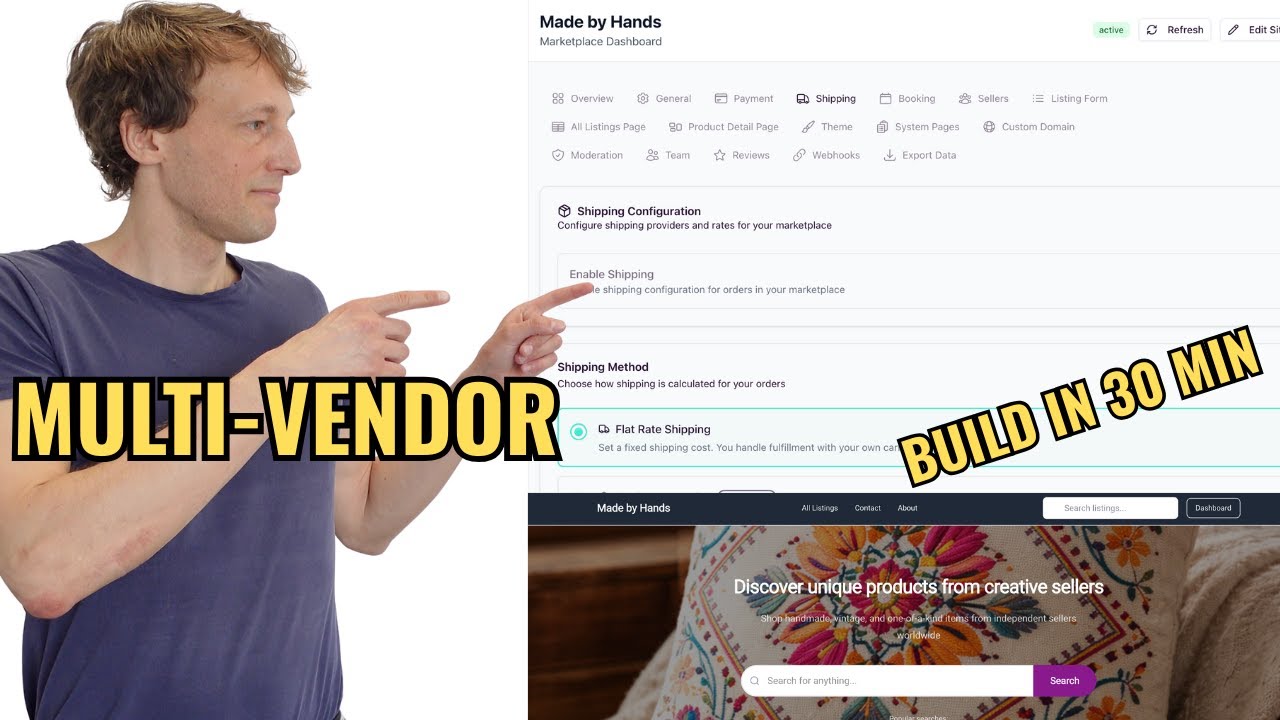
How to Build a Multi-Vendor Marketplace in 2026 (Step by Step)
From idea to first transaction without writing payment code or hiring a dev team
Ready to build your marketplace?
Turn your marketplace idea into reality. No coding required.
Start Free Trial