
Tutorial
Ecommerce Marketplace 2026: How to Build One Like eBay or Etsy
Want to build an ecommerce marketplace like eBay or Etsy in 2026? Most founders fail before version one because of payments, the cold-start problem, and admin tooling. Here is how to avoid it.
Everyone says the same thing: "Build a marketplace like eBay." You Google it - and it sounds so simple. Just build a marketplace.
But what no one really talks about is how hard it actually is in the real world. Because the hard part isn't creating a website with listings. The hard part is everything else.
Examples include eBay (auctions and resale), Amazon Marketplace (third-party sellers), Etsy (handmade goods), Walmart Marketplace (consumer goods), Mercari (peer-to-peer resale), and Poshmark (fashion).
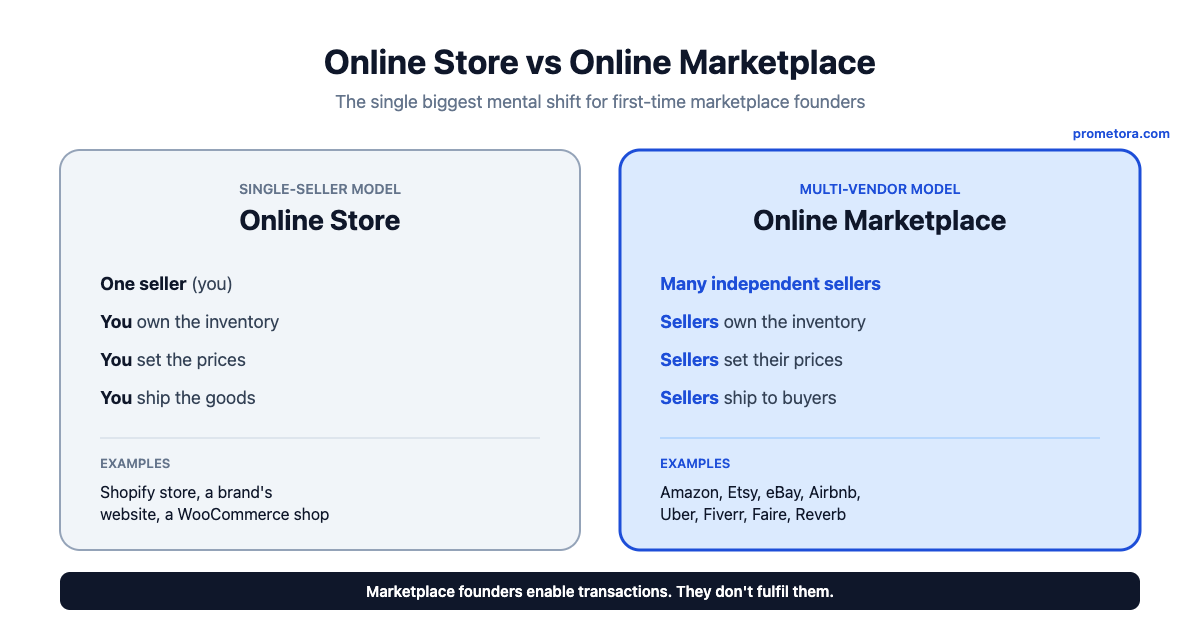
Unlike a single-seller online store, an ecommerce marketplace has many sellers and many buyers - and the platform takes a commission on each sale.
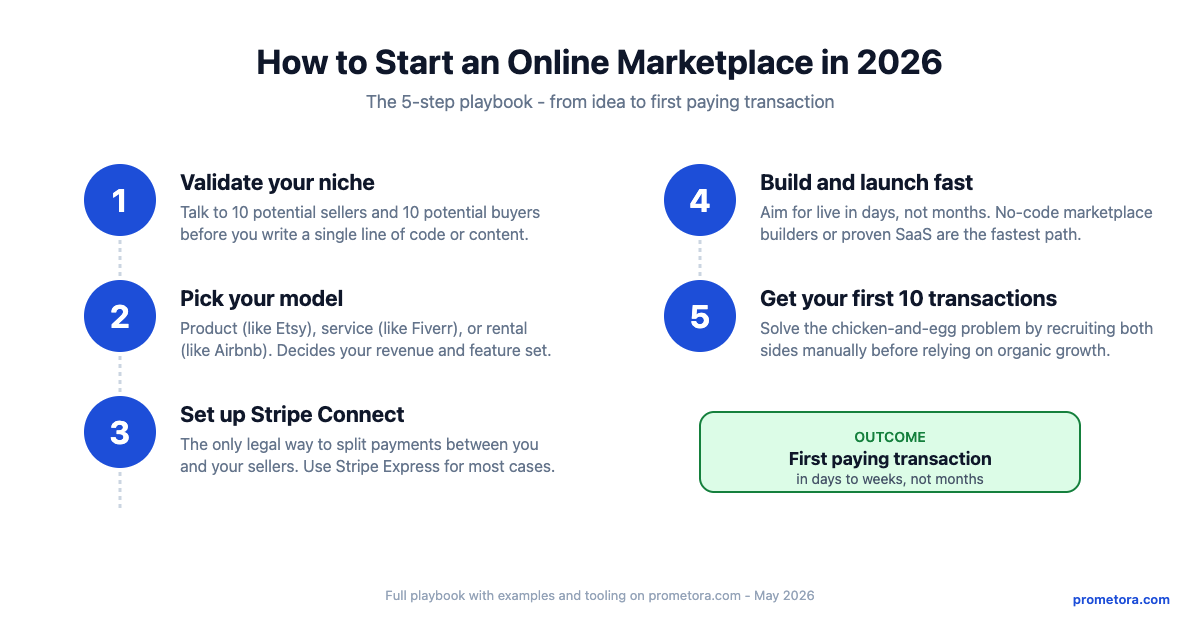
1. Pick a product niche with proven seller demand - handmade goods (Etsy), musical instruments (Reverb), sneakers (StockX), wholesale (Faire), peer-to-peer resale (Mercari). Vertical wins over horizontal.
2. Validate with 10 sellers and 10 buyers in that niche before writing code. The hardest part is supply - if 10 sellers won't commit, your model needs work.
3. Set your commission. Most ecommerce marketplaces charge 5-15% (eBay ~13%, Etsy 6.5% + transaction fees, Amazon 15%). You can charge less and use that as a wedge - or charge more and offer better curation.
4. Connect Stripe Connect to split payments automatically between you and your sellers. This is the only legal way to move money between buyers and multiple sellers.
5. Recruit your first 10 sellers manually. Photograph their listings, write the first descriptions, get reviews on the first 10 transactions. Quality of supply > quantity.
Read the full video transcript▼
Why building a marketplace is harder than it sounds (0:00)
Everyone says the same thing: build a marketplace like eBay. You search it on YouTube, you Google it, and it sounds so simple - just build a marketplace. But what no one talks about is how hard it actually is in the real world. Because the hard part isn't creating a website with listings. It's all the other things. Payments, getting sellers before buyers, trust, admin tools, shipping - all the boring stuff you don't think about when you start.
Most people don't fail because their marketplace idea is bad. They fail because they never get past version one. I know this because I've been building niche marketplaces myself. That's where I realized: when you say "just build a marketplace," that's a massive understatement.
My Nordic Mugs story (0:44)
In my case, one of the marketplaces I decided to build was a very niche one. It's called Nordic Mugs, a marketplace for buying and selling Moomin mugs. I actually picked something super niche on purpose because I thought that building a niche marketplace would be easier. But once I actually started building it, I realized very quickly that wasn't the case.
The real reason marketplaces fail (the cold start problem) (1:03)
The hardest part wasn't the idea or the building. It was the cold start problem. I built it, and then I realized I needed sellers before buyers - but buyers wouldn't come without listings first. So: sellers first. Then payments, trust, moderation, admin tools, and all the stuff you have to build on top.
Suddenly I realized I wasn't building another website - I was building a system. At that point it stopped feeling like a side project. That's also when it clicked for me: building a marketplace isn't a simple feature or a simple website. It's a whole machine. And just to show you, this is what my marketplace Nordic Mugs actually looks like.
The usual problem with building an ecommerce marketplace like eBay (1:59)
After building Nordic Mugs, I started noticing a pattern - not only on my own marketplace, but on pretty much every marketplace idea I saw online. Most marketplaces don't fail because the idea is bad. They fail because they never manage to ship the first version. And the reason isn't motivation - motivation is usually there. It's friction. There's just too much setup, too many tools, too many decisions you have to make very early on.
You're suddenly sitting there having to decide things like: what tech stack should I use? What payment provider? What about shipping, moderation, how do listings actually work? And none of those decisions move you any closer to your first users. What happens is people get stuck building the perfect marketplace - an eBay clone with all of eBay's features - before anyone has even signed up. By the time they're halfway there, they burn out.
That's when it really hit me. The real problem isn't building an eBay clone. It's getting to version one fast enough to see if anyone actually cares. Because marketplaces aren't proven on paper. They're proven by getting users and getting them to transact. That's when you know you've actually built something useful. If you can't get there quickly enough, your idea never really gets a chance.
After going through all this, my first idea wasn't to build a no-code tool. I actually went the opposite way. I built a marketplace boilerplate - something developers could use to build marketplaces faster. On top of that, I even created a course for becoming an AI marketplace developer. That helped to a point. But the biggest friction was still there: you still needed to be technical, and you still needed to make dozens of decisions before you could launch.
How Prometora approaches marketplace building (4:02)
That's when I started asking a different question. What if you could create your marketplace as easily as just describing it - so marketplace founders could focus on their idea, their niche, and on getting users, instead of on what tech to use, what payment provider, and the whole setup? This question didn't come from wanting to build another tool. It came from frustration - from building real marketplaces and seeing where people get stuck.
That's what eventually led to Prometora. Instead of starting with code or a blank project, Prometora starts with the idea itself. You describe the marketplace you want to build, the niche, and how you want it to work. From that description, Prometora generates the foundation for your marketplace - not just the pages, but the structure behind it. Because all marketplaces are quite different. Compare Airbnb to eBay, for instance. So Prometora generates the flow your marketplace runs on.
What matters to me here isn't replacing developers. It's removing the unnecessary decisions at the very beginning, without limiting what you can build later. You shouldn't have to lock yourself into a tech stack before you've talked to real users on your marketplace.
The goal with Prometora is to get you to version one fast, but on top of infrastructure designed to grow with you no matter how big you become. So if and when you become the next Airbnb-sized marketplace, you can still keep it on Prometora. When real users start showing up, you're not throwing anything away. You're improving, extending, and scaling what already exists. Prometora isn't trying to guess the final shape of your business on day one. It's giving you a foundation that works for your first user and still makes sense when you have hundreds of thousands.
Who Prometora is for (5:59)
If you're thinking about building a marketplace - whether it's small, niche, or something much bigger - the way I think about it is this: marketplaces aren't built in one moment. They're built by shipping, learning from users, iterating, shipping again, learning more, iterating again. That's how it goes.
Prometora is built for marketplace founders who want to start from an idea, build fast without cutting corners, and stand on infrastructure that doesn't box them in later as they grow. It's not for people trying to build a one-click business - Prometora doesn't replace thinking. There's still real work to do. You still have to figure out how to get users to actually use your marketplace. So it's for people who want to focus on the marketplace itself - the niche, the users, the dynamics - instead of getting stuck in setup before anything real exists.
If that sounds like you, go ahead and test out Prometora and see what it can generate from your marketplace idea. No pressure - just check it out and see if it fits how you think. And if you're interested in marketplace building in general - what works, what fails, how to build them - please subscribe to this channel. This is where I'll be sharing my learnings along the way. Thanks for watching, and I'll see you in the next one.
The Real Problem Nobody Talks About
Payments. Getting sellers before you have buyers. Trust. Shipping. Admin tools. Moderation. Disputes. Refunds. All the boring stuff you don't even think about when you start.
And most people don't fail because their marketplace idea is bad. They fail because they never get past version one.
I know this because I tried building a niche marketplace myself - and very quickly realized that "build a marketplace" is a massive understatement.
A Real Example: Nordic Mugs
One of the marketplaces I decided to build was very niche. It's called Nordic Mugs - a marketplace just for buying and selling Moomin mugs. I picked something super specific on purpose, because everyone says niche marketplaces are easier, right?
But once I actually started building it, I realized something pretty fast: the hardest part wasn't the idea - it was the cold start.
I needed sellers before I had buyers. But buyers wouldn't come without listings. Then came payments, trust, moderation, admin tools… Suddenly I wasn't just building a website - I was building a system.
At that point, it stopped feeling like a side project. And that's when it really clicked for me: building a marketplace isn't a single feature - it's a whole machine.
Why Founders Get Stuck
You're suddenly deciding things like:
• Which tech stack?
• Which payment provider?
• How do listings work?
• What about moderation?
• Shipping integration?
None of these decisions move you closer to your first user.
What happens is people get stuck trying to build the "perfect" marketplace - an eBay clone with every feature - before anyone has even signed up. And by the time they're halfway there, they burn out.
The Big Insight
The real problem isn't building an eBay clone. It's getting to version one fast enough to see if anyone actually cares.
Because marketplaces aren't proven on paper. They're proven by real users doing real transactions. And if you can't get there quickly, the idea never even gets a chance.
After going through all of this myself, I started asking a different question: What if creating a marketplace was as easy as describing it? What if founders could focus on the idea, the niche, and the users - instead of frameworks, stacks, and setup?
That question didn't come from wanting to build another tool. It came from frustration - from building real marketplaces and seeing where people actually get stuck. And that's what eventually led to Prometora.
What Every Marketplace Actually Needs
Forget feature lists with 50 items. Every functioning marketplace runs on the same core infrastructure:
- Listings - The foundation. What people can buy, sell, rent, or book.
- Users - Buyers and sellers with accounts, profiles, and reputation.
- Transactions - Money flowing through the platform, not around it.
- Trust - Reviews, verification, and protections that make strangers comfortable transacting.
- Admin tools - Moderation, approvals, and controls to run the marketplace.
Everything else - advanced search filters, mobile apps, analytics dashboards, AI recommendations - can come later. The goal is to enable the core transaction first.
How to Create an Online Marketplace Like eBay in 2026
Most "how to build a marketplace" guides skip the hard parts and jump straight to features. Here's the actual 6-step playbook for going from idea to live ecommerce marketplace - based on what I learned building Nordic Mugs and watching dozens of other marketplace founders get stuck.
- 1
Pick a product niche - don't try to out-eBay eBay
Generic "marketplace for everything" doesn't beat eBay or Amazon at their own game. The ecommerce marketplaces that actually win pick a specific category and own it: Etsy (handmade and vintage), Mercari (peer-to-peer resale), Poshmark (fashion), Reverb (musical instruments), StockX (sneakers and streetwear). Pick a category where buyers care about expertise, curation, or trust - things horizontal marketplaces can't replicate.
- 2
Validate before building (10 sellers, 10 buyers)
Don't write code yet. Talk to 10 potential sellers in your niche - would they list on a platform like this? What would convince them to switch from eBay or Etsy? Talk to 10 potential buyers - are they actively looking for what you'd offer? Where do they currently shop? If you can't get 10 people excited on each side, the niche probably isn't viable. Pivot before you build.
- 3
Define listings, categories, and shipping
Ecommerce marketplaces live or die on listing quality. Hosts/sellers need to specify product condition, photos, dimensions, weight, shipping options, and category. Decide upfront: do sellers handle shipping themselves, or do you offer label generation? Will you support international? Returns? With Prometora, listings + categories + shipping are configured per-marketplace in the admin - no plugins, no patchwork.
- 4
Set commission and connect Stripe Connect
Most ecommerce marketplaces charge 5-15% commission on each sale. eBay charges around 13%, Etsy 6.5% + transaction fees, Amazon 15%. You can charge less and use that as a wedge - or charge more and offer better service or curation. Either way, you need Stripe Connect to split payments between sellers and your platform automatically. Building it from scratch is weeks of webhook work; on Prometora it's a guided setup.
- 5
Recruit your first 10 sellers (manually, with quality)
Empty marketplaces stay empty. Before you tell anyone about your marketplace, recruit 10 sellers personally. Help them photograph their inventory, write good descriptions, and price competitively. Quality over quantity - 10 great listings beats 100 mediocre ones because new sellers will judge your platform by what's already on it. "Do things that don't scale" applies here more than anywhere else.
- 6
Drive your first 10 transactions
With listings live, you need buyers. Show up where your specific niche hangs out: subreddits for the category, Facebook groups, Discord servers, niche directories. Show up with genuine value - not just a link drop. Ask your sellers to share their listings to their own audiences (every seller has some kind of following). Treat the first 10 buyers like VIPs - their reviews are the social proof that lands the next 100.
All 6 steps can happen in days on a guided platform. The hard part isn't the build - it's steps 1, 5, and 6. Pick the platform that gets steps 3 and 4 out of the way fastest, so you can focus on the niche and the people.
Niche ecommerce marketplaces that win
These platforms didn't try to out-eBay eBay or out-Amazon Amazon. They picked one focused vertical - handmade, sneakers, instruments, fashion - and built features and trust the horizontal giants couldn't replicate. Here are the lessons worth stealing.
Handmade, vintage, and craft supplies
Picked the slice eBay ignored - handmade and vintage - and built buyer expectation that products are uniquely made, not mass-produced. Now does $13B+ in annual GMV.
Musical instruments and gear
Vertical specialization for guitars, synths, drums, and pro audio. Built community + expertise that horizontal marketplaces couldn't match. Etsy acquired them for $275M in 2019.
Sneakers, streetwear, and collectibles
Solved authentication for collectible sneakers - the trust problem eBay couldn't fix at scale. Specialization let them charge premium fees. $400M+ revenue at peak.
Mobile-first peer-to-peer resale
Snap a photo, set a price, ship. Lowered the listing friction for casual sellers - eBay's listing flow couldn't match the simplicity. Public company with billions in GMV.
Fashion resale and community
Made resale social - parties, follow lists, comments. Turned listing and buying into a community activity, not just commerce. Acquired by Naver for $1.2B in 2023.
Wholesale for independent retailers (B2B)
B2B niche - independent retailers buying from indie brands. NET 60 payment terms and free returns gave brick-and-mortar shops a way to compete with Amazon. $12B valuation.
Calculate Before You Build
Most founders get excited about features but don't know what their marketplace will actually earn. Before you spend months building, understand the math: your break-even point, monthly revenue potential, and how it scales with different commission rates.
Net Monthly Revenue
$276
After Prometora & Stripe fees
Annual Projection
$3,312
Net revenue at this volume × 12
Above Break-Even
36 orders
64 above — subscription covered
Your Settings
Per Transaction Breakdown
Billed to you once a month with your subscription
Deducted from seller · US card rate
Per sale, before your monthly subscription
Monthly Projections
Yearly Projections
Like the look of $276/month?
Start a free 14-day trial and turn this projection into a real marketplace.
Revenue Growth Chart
Visualize how your net revenue scales with order volume
Monthly orders → Net revenue/month
Scaling Projections
See how your revenue grows as your marketplace scales (based on $50 AOV, 10% commission, Professional plan)
| Orders | GMV | Commission | Fees | Net |
|---|---|---|---|---|
| 50 | $2,500 | $250 | -$187 | $64 |
| 100Current | $5,000 | $500 | -$224 | $276 |
| 250 | $12,500 | $1,250 | -$337 | $914 |
| 500 | $25,000 | $2,500 | -$524 | $1,976 |
| 1,000 | $50,000 | $5,000 | -$899 | $4,101 |
Ready to Start Earning?
With 100 orders at $50 AOV, you could be earning $276/month. Start building your marketplace today.
Trusted by Marketplace Founders
“After trying independent developers and other platforms I decided to give Prometora a try to get my training marketplace site off the ground. I’m so happy I found Prometora - it was very easy to get started and has capabilities that far exceed those of the other platforms I tried. The support at Prometora has been incredible as Rasmus is constantly updating and improving the platform. Prometora is simple enough for beginner developers like me but powerful enough to bring any concept to reality.”
Elliott Cooper
Founder, Spotlox — Canadian training marketplace
“I wanted a reliable partner, and choosing Prometora was undoubtedly the best decision for developing Perigoodies. The team’s guidance and dedication made my job much easier, and their responsiveness and support far exceeded my expectations and are greatly appreciated.”
Nelly P.
Founder, Perigoodies — Périgord artisan & gourmet marketplace
Frequently Asked Questions
1. Pick a product niche with proven seller demand. Handmade goods, musical instruments, sneakers, wholesale, peer-to-peer resale all have winning examples. Vertical beats horizontal.
2. Validate with 10 sellers and 10 buyers in that niche before writing code.
3. Set your commission (most ecommerce marketplaces charge 5-15%).
4. Connect Stripe Connect to split payments automatically between you and your sellers.
5. Recruit your first 10 sellers manually. Quality of supply matters more than quantity - one trusted seller with 50 great listings beats 50 sellers with one listing each.
The broad marketplace-startup playbook is in how to start an online marketplace. For multi-vendor ecommerce specifically (multiple sellers, you take commission), see how to build a multi-vendor marketplace.
• Prometora - AI-generated setup, multi-seller payouts via Stripe Connect, custom listing fields. From $99/month.
• Sharetribe - established marketplace SaaS, template-based. Lite $99/mo yearly or $139/mo monthly.
• CS-Cart Multi-Vendor - self-hosted, $61/mo annual (Standard). No platform transaction fees but you handle hosting.
For a feature-by-feature breakdown across all 10+ platforms, see the marketplace software comparison.
Most successful marketplaces solve this by focusing on one side first - usually supply. Recruit sellers manually, seed the platform with quality listings, and create the appearance of activity before investing heavily in buyer acquisition.
Modern marketplace software like Prometora lets you launch for a fraction of that cost - often under $100/month - because the core infrastructure is already built. The real question is how much you should spend before validating your idea with real users.
Before you invest, it's important to understand your marketplace math - what commission rate you'll charge, your expected order volume, and when you'll break even. Use the calculator above →
Marketplaces are more complex because you're managing two sides - supply and demand - plus payments, trust, and disputes between parties you don't control.
Use marketplace software to validate your idea first, get real users, and prove the business model. You can always migrate to custom later with real revenue and clear requirements.
Today, no-code and low-code marketplace platforms let non-technical founders launch and iterate without writing code. You can always add custom development later once you've validated demand.
Everything else - reviews, advanced filters, analytics, mobile apps - can come later. Most founders over-build before they have users. Focus on enabling the core transaction first.
• Talk to potential sellers - would they list?
• Talk to potential buyers - are they actively looking?
• Check if people are already solving this problem manually (Facebook groups, spreadsheets, forums)
• Consider a simple landing page to collect interest before building anything
Validation should happen before your first line of code.
• They got stuck in endless setup and technical decisions
• They tried to build everything before launching anything
• They ran out of motivation before proving the model
The founders who succeed are the ones who ship fast, learn from real users, and iterate.
The real timeline depends on how much you customize and how quickly you make decisions. Founders who launch fast and iterate based on real feedback consistently outperform those who spend months building in isolation.
See the full marketplace software comparison →

Related Guides
Keep going - these cover the next questions most marketplace founders have.
Marketplace Fundamentals
How to Start an Online Marketplace in 2026: 5-Step Playbook
The complete guide to going from idea to launch - without wasting months or money
Marketplace Fundamentals
What Is an Online Marketplace? Definition, 4 Types & Examples
A beginner's guide to understanding marketplace fundamentals
Tutorial
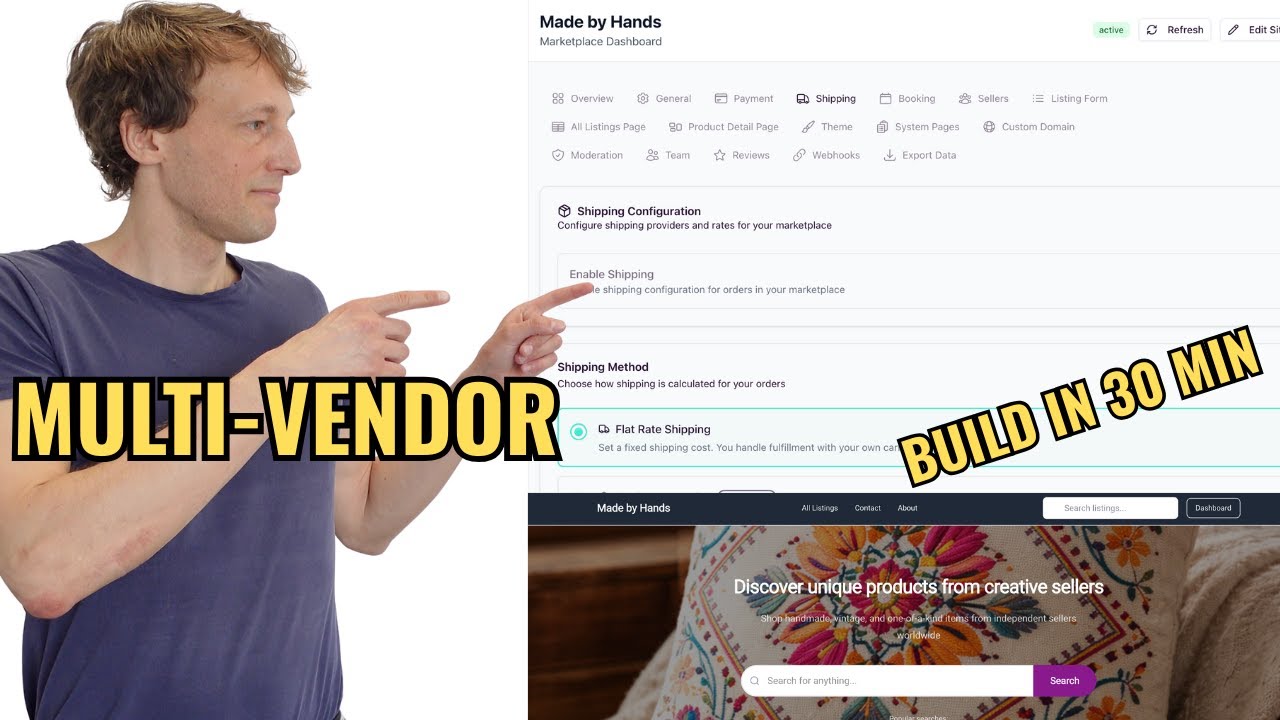
How to Build a Multi-Vendor Marketplace in 2026 (Step by Step)
From idea to first transaction without writing payment code or hiring a dev team
Ready to build your marketplace?
Turn your marketplace idea into reality. No coding required.
Start Free Trial